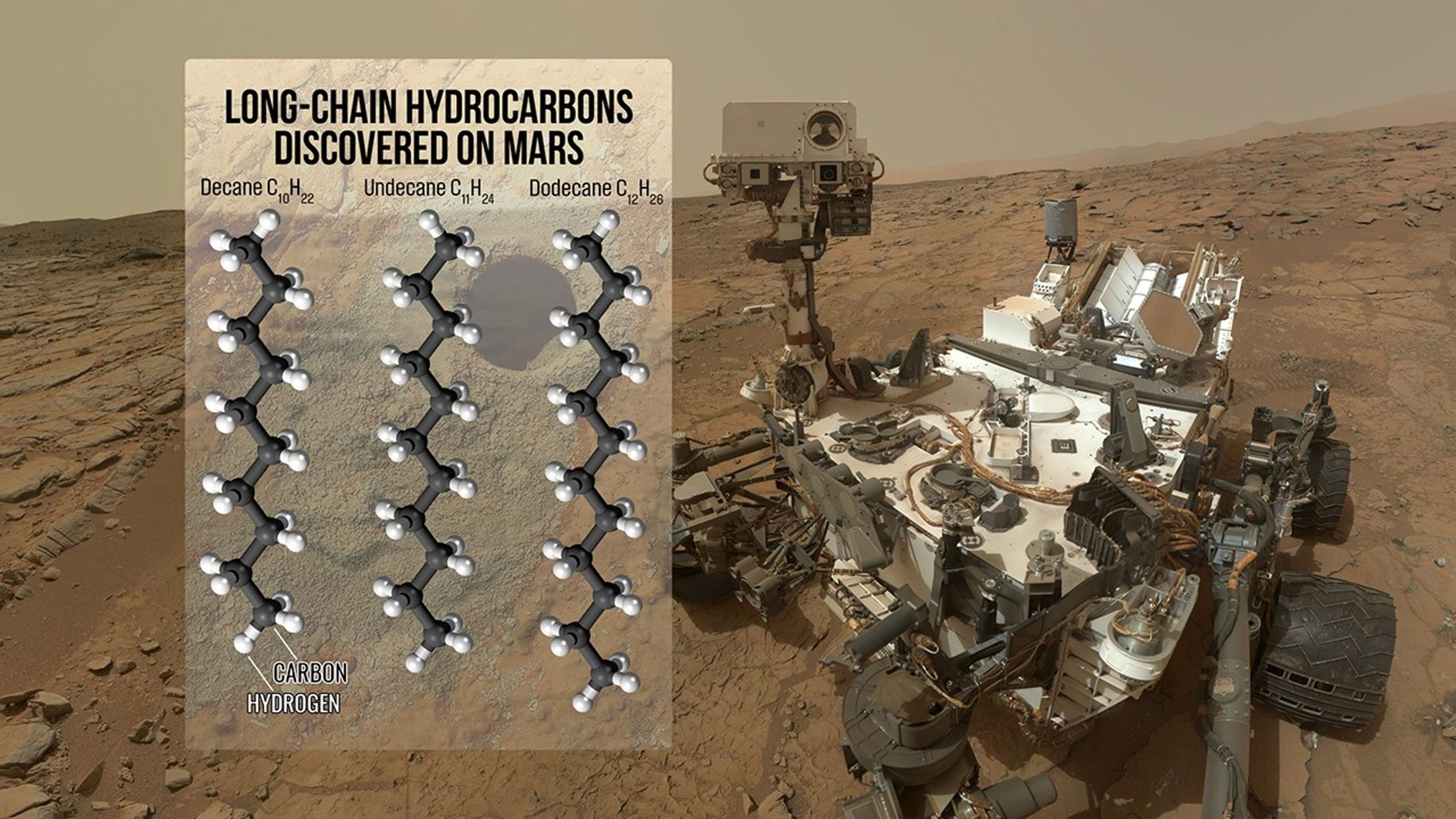
Scientists have discovered the largest organic molecules ever detected on Mars embedded in a 2.5-billion-year-old mudstone, raising the possibility – though not proof – of past life on the Red Planet. The complex hydrocarbons, resembling fatty acids, cannot be fully explained by known non-biological processes, making a biological origin “reasonable” according to a new NASA-led study published in Astrobiology.
The Discovery in Cumberland Mudstone
The organic molecules were found within the Cumberland mudstone, a fine-grained sedimentary rock in Gale Crater’s Yellowknife Bay – an ancient Martian lakebed. The Curiosity rover first drilled into this stone in 2013, but the discovery of these large alkanes (hydrocarbon chains with 10 to 12 carbon atoms) was only made after heating the sample to extreme temperatures (1,100°C) while searching for amino acids. These alkane chains are larger than those typically formed by abiotic processes, meaning they’re more likely to have a biological origin.
Rewinding Martian History
The initial abundance of these organic molecules is difficult to assess because billions of years of exposure to cosmic and solar radiation have degraded them. Researchers used mathematical modeling and data from laboratory simulations (radiolysis experiments) to estimate the original concentration, concluding that the current levels (30–50 parts per billion) likely represent just a fraction – possibly many times less – of what was present when the mudstone first formed.
Ruling Out Non-Biological Origins
The study systematically evaluated how these molecules could have arisen without life. Several scenarios were dismissed:
- Space Delivery: Interplanetary dust and meteorites bring organic matter to Mars, but cannot penetrate rock or explain the concentrations observed.
- Atmospheric Settlement: The ancient Martian atmosphere was too thin to produce enough organic material through settling.
- Water-Rock Interactions: Typically yields smaller organic molecules, not the long chains discovered.
- Hydrothermal Systems: While possible, this would require high temperatures not evident in the Cumberland sample.
Why This Matters: The Search for Extraterrestrial Life
These findings are significant because they narrow the possibilities for the origin of these molecules. While not definitive proof of life, they strengthen the argument that ancient Mars may have been habitable. The presence of clay minerals, nitrates, and sulfur in the same sample further supports this idea, as these compounds are crucial for biological processes. The long duration of water presence in Gale Crater means there was ample time for life-forming chemistry to occur.
Limitations and Future Prospects
The Curiosity rover’s analytical capabilities have limits. Larger, more complex organic molecules – strongly linked to biological activity – may be beyond its detection range. The next step is to replicate Martian conditions on Earth to better understand how these molecules behave. Ultimately, retrieving actual Martian mudstone samples via a future sample-return mission is essential for conclusive analysis.
The researchers emphasize that while they cannot rule out non-biological origins entirely, the unexplained abundance of these organic molecules makes a biological hypothesis “reasonable” and warrants further investigation.