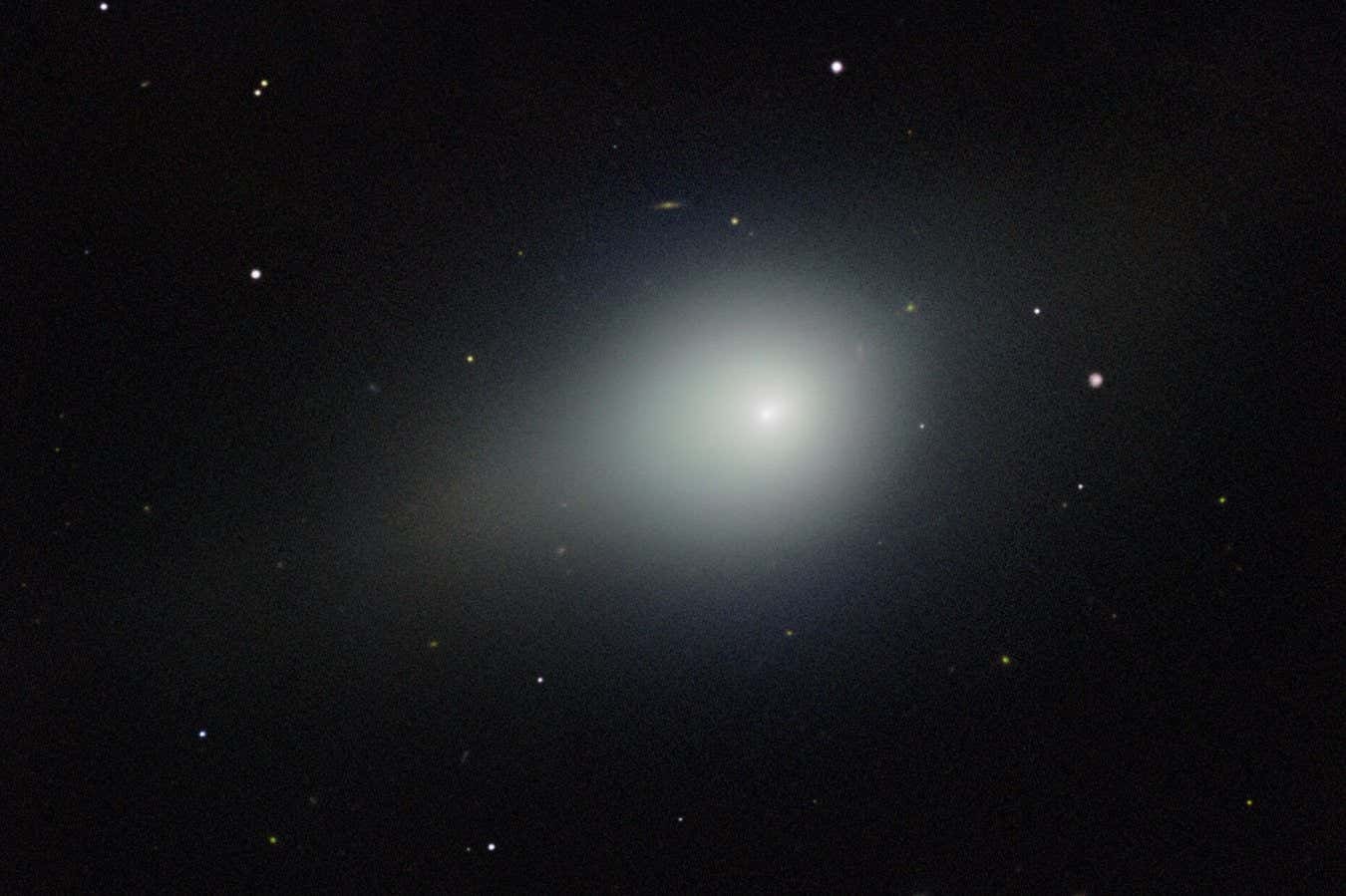
An interstellar comet, designated 3I/ATLAS, is challenging our understanding of planetary system formation. This space traveler, recently observed passing through our solar system, contains water and carbon molecules in proportions unlike anything found within our own celestial neighborhood. The data suggests it originated from a star system far older and fundamentally different from our Sun.
An Unusually Ancient Visitor
Astronomers first spotted 3I/ATLAS last year, and its composition has already defied expectations. Initial observations revealed unusually high concentrations of carbon dioxide and water. More recent analysis, utilizing the James Webb Space Telescope, has confirmed that the comet is approximately 8 billion years old – nearly twice the age of our Sun.
The most striking finding, however, lies in the levels of deuterium, a heavier form of hydrogen. Deuterium naturally occurs in trace amounts in Earth’s oceans, but 3I/ATLAS boasts concentrations over 40 times higher. According to Martin Cordiner at NASA’s Goddard Space Flight Center, “3I/ATLAS continues to astonish us with what it reveals about the similarities and differences of its host system compared with our own solar system.”
Implications for Star System Evolution
The extreme deuterium ratio suggests that 3I/ATLAS formed in the frigid outer reaches of a protoplanetary disk surrounding its parent star. These conditions make ejection from the system more likely, explaining why it now wanders interstellar space.
Furthermore, the comet’s carbon composition provides another clue to its age. Relatively low levels of carbon-13, an isotope produced by supernovae, indicate that it arose in a galactic environment with less stellar “pollution.” This points to an origin in a star system between 10 and 12 billion years old, predating our Sun by a significant margin. As Ewine van Dishoeck from Leiden Observatory explains, this suggests it formed when the Milky Way was a quieter place, with fewer exploding stars.
Unanswered Questions Remain
While current data strongly implies an ancient origin, some uncertainties persist. The precision of carbon isotope measurements is still debated, leaving room for alternative interpretations. Nevertheless, 3I/ATLAS offers a unique window into the diversity of planetary system formation across the galaxy. Its existence confirms that other star systems can evolve in drastically different ways than our own, and that some may harbor conditions conducive to the formation of long-lived cometary bodies.
The discovery of 3I/ATLAS highlights the importance of continued interstellar object research. Each such visitor holds the potential to reshape our understanding of cosmic history and the prevalence of habitable environments beyond Earth.