For the first time in history, humans have demonstrably changed the orbital path of an asteroid around the Sun. The achievement, a direct result of NASA’s 2022 Double Asteroid Redirection Test (DART) mission, isn’t just about nudging a space rock; it’s a landmark demonstration of our capacity to influence celestial mechanics.
The DART Mission: A Controlled Impact
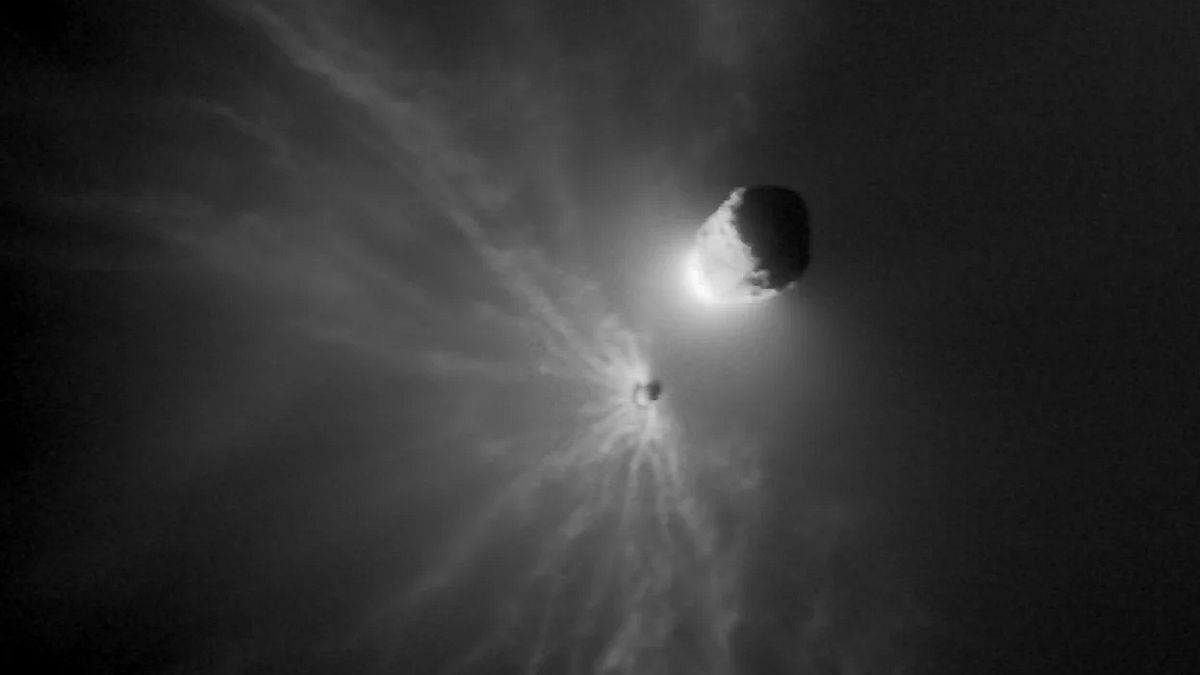
The DART mission deliberately collided a spacecraft with Dimorphos, a smaller asteroid orbiting the larger Didymos. The goal wasn’t destruction, but deflection. Initial results already showed the mission shortened Dimorphos’ orbital period around Didymos by an impressive 33 minutes. New data confirms this impact also subtly altered the entire Didymos-Dimorphos system’s trajectory through space.
This matters because it proves a concept vital to planetary defense. The Solar System is filled with asteroids, and while no immediate threat to Earth exists, preparation is critical. The DART experiment validates the possibility of diverting a potentially hazardous asteroid if given enough warning.
How the Orbit Was Changed
The asteroids Dimorphos (160 meters across) and Didymos (780 meters across) were chosen because their well-defined orbit made measurements easier. The impact wasn’t just about pushing Dimorphos; it also ejected debris into space. This material carried momentum away from the system, creating a minuscule recoil that shifted the pair’s overall motion around the Sun.
Researchers analyzed data from over 6,000 ground-based observations, stellar occultations, and spacecraft measurements. The results show the system slowed by about 11.7 micrometers per second—roughly 42 millimeters per hour. While seemingly insignificant, this change accumulates over time: about 3.69 kilometers over a decade.
Planetary Defense Implications
The implications are clear. Even small nudges, applied years or decades in advance, could be enough to safely shift an asteroid away from Earth. This is not science fiction; it’s a tested capability.
The European Space Agency’s Hera mission, due to arrive at the Didymos system later this decade, will provide further data on the impact crater and the asteroids’ internal structure. But the core takeaway remains: humanity can now actively alter the orbits of celestial bodies.
“By demonstrating that asteroid deflection missions such as DART can effect change in the heliocentric orbit of a celestial body,” the researchers write, “this study marks a notable step forward in our ability to prevent future asteroid impacts on Earth.”
This experiment isn’t just about theoretical safety; it’s a demonstration of practical, actionable defense against a low-probability, high-consequence threat.