Astronomers have significantly expanded our map of the Milky Way by discovering dozens of faint, ribbon-like structures known as stellar streams. Using data from the European Space Agency’s Gaia mission, researchers have identified 87 potential stellar stream candidates—a massive leap from the fewer than 20 previously known.
This discovery, led by Yingtian “Bill” Chen of the University of Michigan, provides a much larger dataset for scientists attempting to decode the history of our galaxy and the mysterious forces that govern it.
What are Stellar Streams?
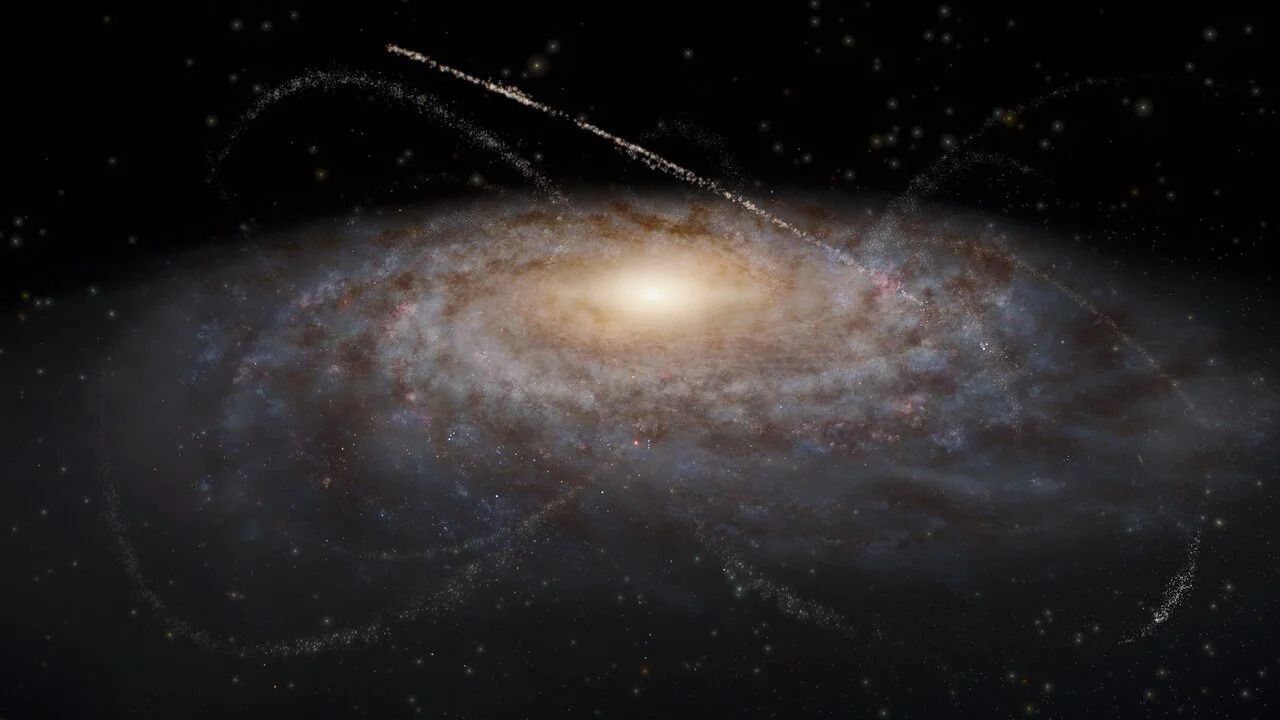
Stellar streams are long, thin trails of stars that form when compact groups, such as globular clusters, travel through the Milky Way’s gravitational field. As these clusters orbit the galaxy, gravitational forces pull at them, gradually stripping stars away.
To visualize this process, study co-author Oleg Gnedin compares it to riding a bicycle with a leaky bag of sand:
“Those grains of sand are like the stars left behind along their trajectory.”
A Breakthrough in Detection: The StarStream Algorithm
Until now, finding these streams was largely a matter of luck. Astronomers typically identified them by chance when they noticed unusual patterns in the data. This limited sample size made it difficult to draw broad scientific conclusions about galactic evolution.
The breakthrough came with the development of StarStream, a new computer algorithm. Unlike previous methods that relied on searching for visual patterns, StarStream uses a physics-based model. By applying theoretical expectations of how stars should behave under gravity, the algorithm can identify structures that are too faint or irregular for the human eye to catch.
Why This Matters for Dark Matter Research
The discovery of these streams is about much more than just finding lost stars; it is a vital tool for mapping dark matter.
Dark matter is the invisible “glue” that provides the gravitational pull necessary to hold galaxies together. While it cannot be seen directly, its presence can be inferred by how it affects visible matter. Because stellar streams are shaped by the gravitational forces they encounter, their paths act as a historical record of the Milky Way’s mass distribution.
By studying these 87 new candidates, astronomers can better understand:
– The Galaxy’s Mass: How much total matter (visible and dark) resides in the Milky Way.
– The Dark Matter Halo: The shape and density of the invisible cloud surrounding our galaxy.
– Cluster Lifespans: The study found that some clusters are shedding stars at unusually high rates, suggesting they are on the verge of being completely torn apart by tidal forces.
Challenging the Status Quo
The new data also reveals that stellar streams are more diverse than previously thought. While astronomers once looked for thin, perfectly aligned ribbons, the StarStream algorithm found many streams that are:
– Shorter and wider;
– Misaligned with the orbits of their parent clusters;
– More diffuse and harder to detect.
This suggests that previous searches were biased toward “obvious” structures, missing a significant portion of the galaxy’s complex architecture.
The Road Ahead
While the study identifies 87 candidates, researchers caution that not all will be confirmed. Some detections may be “false positives” caused by background noise from unrelated stars.
However, the foundation has been laid for a new era of galactic mapping. The StarStream algorithm is designed to be easily adapted for upcoming next-generation observatories, such as the Vera C. Rubin Observatory and NASA’s Nancy Grace Roman Space Telescope, which will provide the high-resolution data needed to verify these findings.
Conclusion
By moving from visual observation to physics-based modeling, astronomers have unlocked a much clearer view of the Milky Way’s structural history. These newly discovered stellar streams will serve as essential guides for mapping the invisible dark matter that shapes our universe.