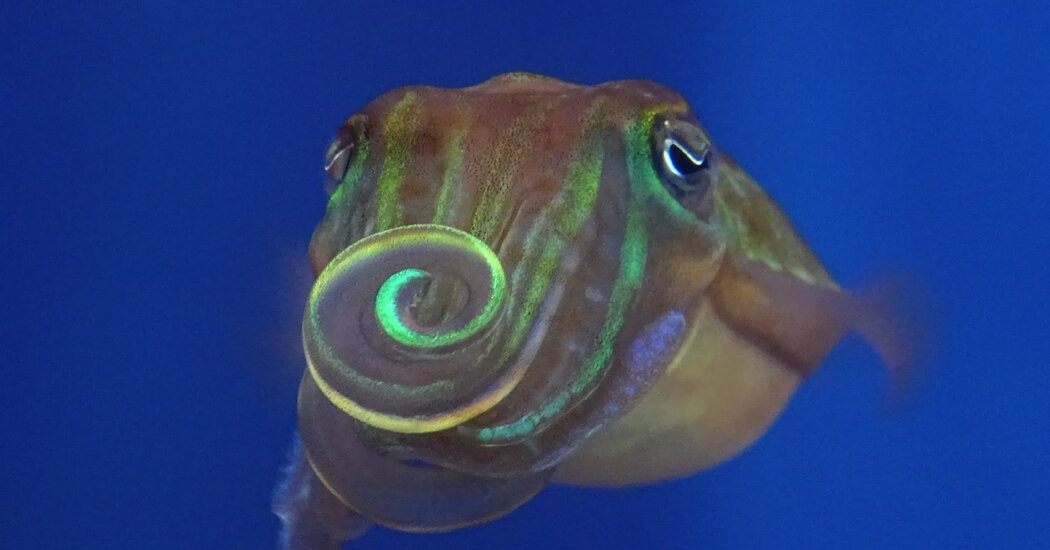
Cuttlefish are now confirmed to use polarized light patterns – visual signals invisible to humans – to attract mates, according to new research published in the Proceedings of the National Academy of Sciences. This discovery marks the first documented case of an animal employing such a sophisticated, yet hidden, form of courtship.
The Hidden World of Polarized Light
Humans perceive light as a simple spectrum of colors. However, many animals – including fish, insects, and cuttlefish – can also detect the orientation of light waves. This means they can see subtle differences in how light travels, perceiving contrasts and textures that are entirely invisible to us. This phenomenon is called polarization.
Imagine light as vibrating waves: some oscillate up and down, others side to side. We don’t notice this difference, but other species do. When light passes through a filter blocking certain orientations, it becomes “polarized,” creating patterns that enhance visibility for those who can see them. Researchers believe polarization adds contrast, making objects “pop” against their background.
How Cuttlefish Exploit Polarization
Cuttlefish, masters of camouflage, can manipulate the pigment cells in their skin to create these polarized patterns. The study demonstrates that male cuttlefish display these invisible signals during courtship. While humans see no difference, female cuttlefish perceive a distinct, attractive visual display.
Why does this matter? It highlights how limited our sensory perception is. The animal kingdom thrives on communication methods we can’t even imagine. This research pushes us to rethink what “beauty” or “attraction” means in nature, as it exists beyond human comprehension.
Future Implications
Understanding polarized communication could change how we study animal behavior. If other species also use this “hidden” visual language, it would explain behaviors that previously seemed inexplicable. The study’s author, Arata Nakayama, emphasizes that visualizing polarization is difficult for humans. “It’s really difficult to know exactly what polarized light looks like to an animal that can see it.”
The cuttlefish discovery is a reminder that much of the natural world operates on frequencies we’re oblivious to, and that some of the most elaborate courtship rituals may occur entirely outside our view.