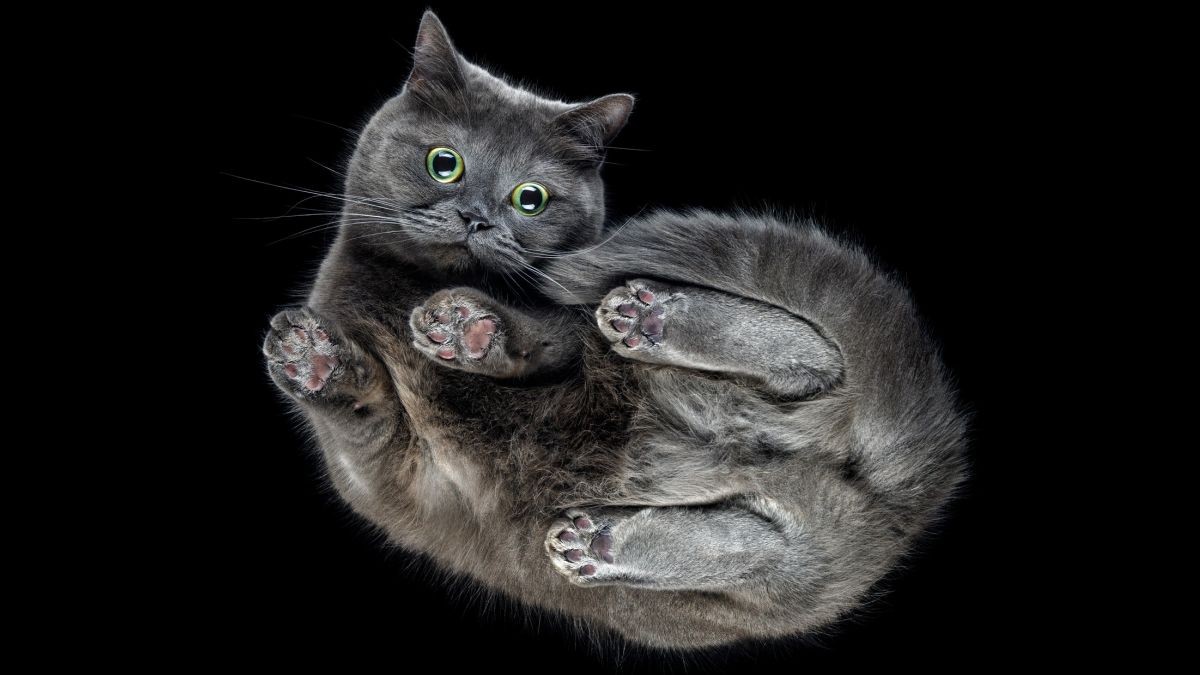
For over a century, the seemingly impossible feat of a falling cat righting itself mid-air has captivated scientists. While the physics of this “falling cat problem” have been explored, a recent study reveals a critical anatomical component: uneven flexibility in the feline spine. Researchers now understand that cats don’t just defy physics – they leverage a unique spinal structure to make it happen.
The Anatomy of a Twist
A team led by Yasuo Higurashi at Yamaguchi University in Japan investigated the mechanics of cat spines. Using donated cadavers, they precisely measured the flexibility, stiffness, and range of motion in both the thoracic (front) and lumbar (back) sections. The results were striking: the thoracic spine is roughly three times more flexible than the lumbar spine, with a significantly wider neutral zone – the range where movement requires minimal force.
This difference isn’t random. The researchers observed that during a fall, cats rotate in two distinct phases. The front half twists first, followed by the back. This sequential rotation is made possible by the front’s greater flexibility and lower mass. The heavier rear end follows, completing the maneuver with remarkable efficiency.
From Photography to Physics: A History of the Puzzle
The “falling cat problem” first gained attention in 1894 when Étienne-Jules Marey captured the phenomenon using high-speed photography. His images showed cats reorienting mid-air in a way that seemed to violate the law of conservation of angular momentum. It wasn’t until 1969 that physicists mathematically proved cats could rotate by twisting different body parts independently, conserving momentum. However, the underlying how remained elusive – until now.
Why This Matters Beyond the Trick
Understanding the mechanics behind a cat’s mid-air rotation isn’t just a curiosity. This unique spinal flexibility may also contribute to a cat’s agility during high-speed movements like galloping and sharp turns. The ability to independently angle spinal sections could provide an evolutionary advantage in hunting and escape.
The study used cadaver spines for testing, but results align with previous research on live cats under anesthesia, reinforcing the findings. Further investigation into the material properties of spines could reveal how this flexibility impacts overall locomotor performance in mammals.
“The sequential rotation of a falling cat, driven by the flexible thoracic spine and rigid lumbar spine, is a testament to the power of anatomical adaptation in defying physics.”
The study provides definitive evidence for why cats consistently land on their feet: it’s not magic, it’s biology.