Imagine standing on a frigid, alien shore. A gentle breeze brushes past your face—hardly enough to disturb a pond on Earth—yet before your eyes, massive, ten-foot waves begin to swell and roll toward the coast in a strange, slow-motion dance.
This is the surreal landscape predicted by “PlanetWaves,” a groundbreaking new computational model developed by researchers at the Massachusetts Institute of Technology (MIT). The model allows scientists to simulate how waves behave on distant worlds, revealing that our Earth-based intuition for ocean dynamics may be completely inapplicable to the rest of the solar system.
Beyond Gravity: The Complexity of Alien Seas
Until now, scientific attempts to model extraterrestrial waves were relatively simplistic, focusing primarily on a planet’s gravitational pull. However, the PlanetWaves model introduces a much more sophisticated set of variables. To accurately predict wave behavior, the researchers account for:
- Atmospheric pressure: How much the air pushes down on the liquid.
- Liquid density: How heavy the substance is.
- Viscosity: The “thickness” or internal friction of the liquid.
- Surface tension: The liquid’s resistance to being deformed or rippled.
To ensure the model’s accuracy, the team first calibrated it using 20 years of buoy data from Lake Superior, Earth’s largest freshwater lake. By successfully replicating Earth’s complex wave patterns, the researchers gained the confidence to apply the model to much more exotic environments.
The Titan Mystery: Oily Lakes and Missing Deltas
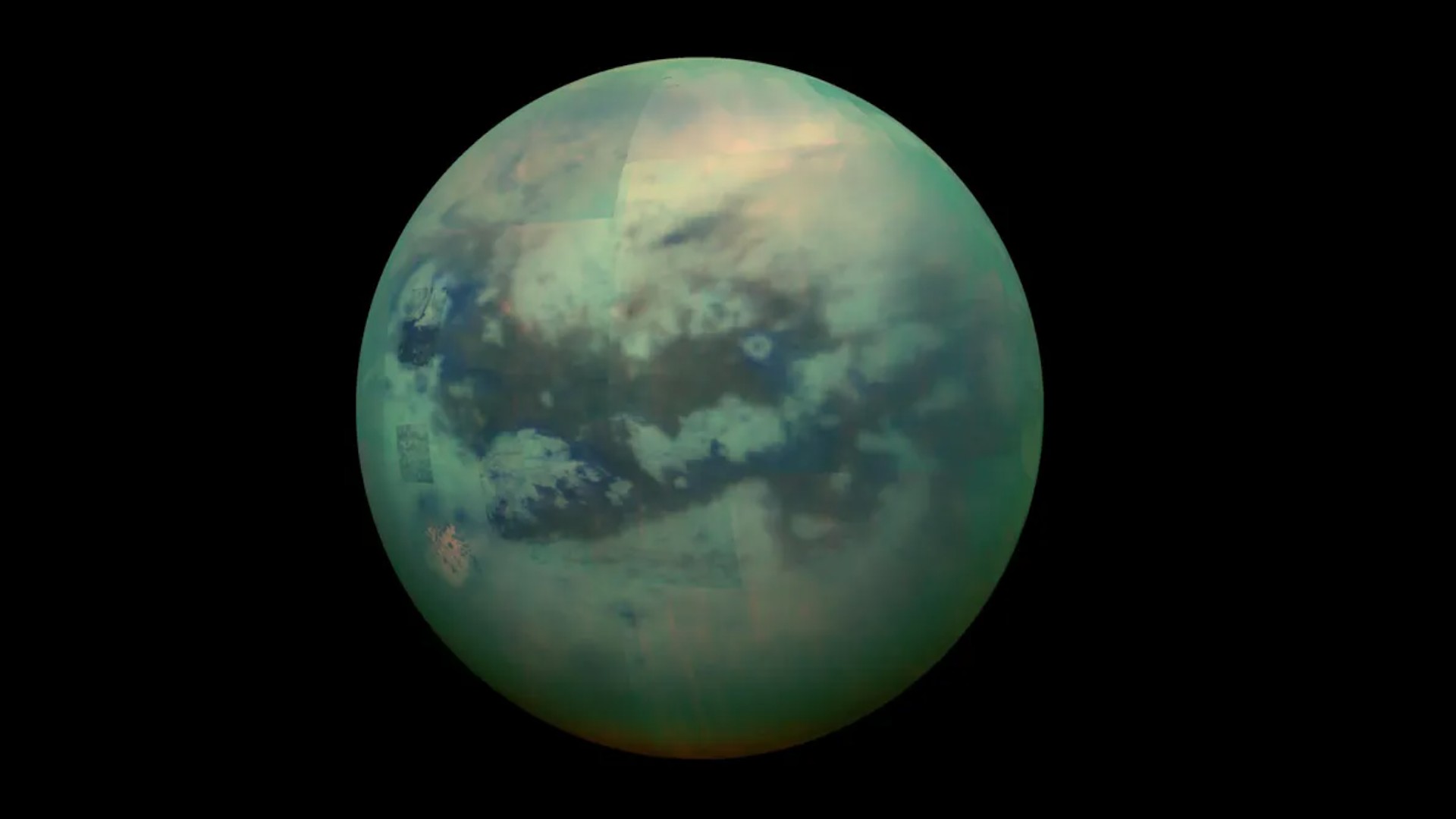
The primary target of this research is Saturn’s moon, Titan. Titan is unique because it is the only other known world in our solar system with stable bodies of liquid on its surface. However, these are not water oceans; they are vast lakes and seas of liquid hydrocarbons, such as methane and ethane, kept liquid by temperatures plunging to –179°C (–290°F).
The model reveals a startling phenomenon on Titan: because the moon has very low gravity (only 14% of Earth’s) and the hydrocarbon liquids are relatively light, even a light wind can generate massive, towering waves.
This discovery may solve a long-standing geological mystery. On Earth, rivers flowing into oceans typically create deltas —fan-shaped landforms created by sediment buildup. On Titan, despite having numerous rivers and coasts, deltas are almost non-existent. The researchers suggest that these massive, slow-moving waves may be constantly eroding the coastlines, preventing deltas from ever forming.
From Lava Oceans to Acid Lakes
The PlanetWaves model was also used to “scout” other potential environments, highlighting just how much planetary conditions dictate fluid movement:
1. The Ancient Mars
While Mars is currently a desert, it once possessed liquid water. As the planet lost its atmosphere and pressure dropped over billions of years, the wind requirements to move water changed. The model helps scientists reconstruct what the Martian “oceans” might have looked like in the past.
2. Exoplanet LHS 1140b
This “super-Earth” is believed to contain significant amounts of water. However, because its gravity is much stronger than Earth’s, any waves on its oceans would be significantly smaller and more stunted than those we see on our own planet.
3. The Acidic Kepler-1649b
On this Venus-like world, researchers speculate the presence of sulfuric acid. Because sulfuric acid is twice as dense as water, it requires much stronger winds to create even a simple ripple.
4. The Lava Seas of 55 Cancri e
Perhaps the most extreme case is the hot exoplanet 55 Cancri e, which may host lakes of molten lava. Due to the extreme viscosity (thickness) of lava and the planet’s high gravity, it would take hurricane-force winds—roughly 80 mph—just to create a single ripple on its surface.
“With this model, we can see how waves behave on planets with different liquids, atmospheres, and gravity, which can kind of challenge our intuition,” says Andrew Ashton of MIT.
Why This Matters for Future Exploration
This research is more than just theoretical curiosity; it is a vital blueprint for future space exploration. If agencies like NASA or the ESA ever decide to send probes to float on Titan’s methane seas, they must know exactly what kind of physical energy those instruments will face. Understanding whether a probe will encounter a gentle ripple or a ten-foot “slow-motion” giant is the difference between a successful mission and a total loss of equipment.
Conclusion: By accounting for the specific chemistry and pressure of alien environments, the PlanetWaves model provides a vital tool for understanding the geological history of our solar system and preparing for the next generation of deep-space exploration.