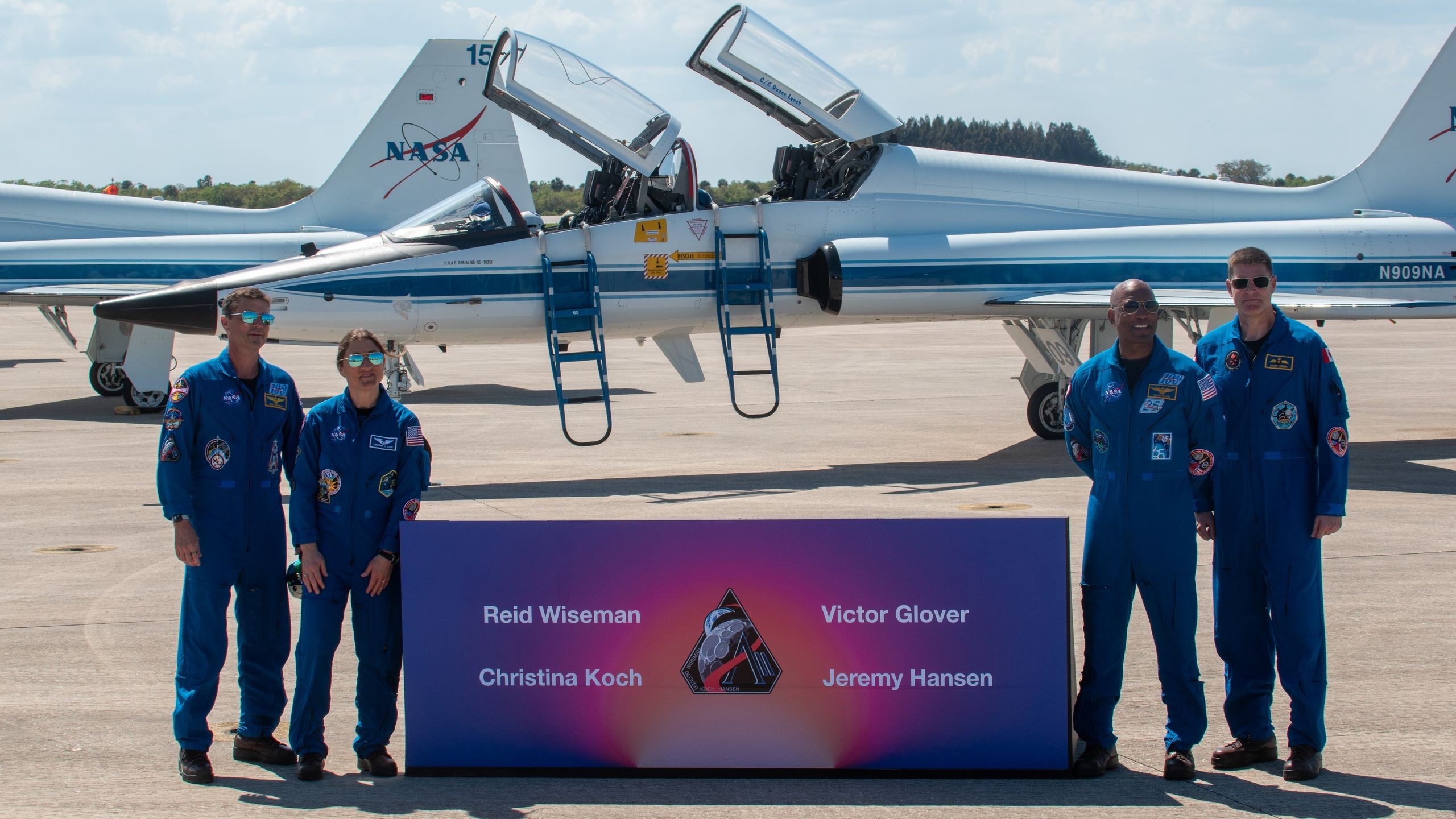
The four astronauts selected for Artemis 2, NASA’s first crewed mission around the moon in over 50 years, have arrived at the Kennedy Space Center (KSC) in Florida. The team – NASA astronauts Reid Wiseman, Victor Glover, and Christina Koch, alongside Canadian Space Agency astronaut Jeremy Hansen – landed at KSC’s Shuttle Landing Facility on March 27th, marking a critical step toward a new era of lunar exploration.
Return to Lunar Orbit: A Milestone in Space Exploration
This mission is not a repeat of the Apollo landings; instead, Artemis 2 will test the Orion spacecraft’s life support systems with a human crew for the first time. The astronauts will fly a ten-day loop around the moon, following a “free-return trajectory” that minimizes engine use after initial lunar injection. This trajectory ensures a direct path back to Earth, streamlining the mission profile while still gathering essential data.
Why this matters: Artemis 2 isn’t just about circling the moon. It’s a crucial testbed for future, more ambitious missions, including crewed lunar landings planned for Artemis 3 (currently scheduled for 2026) and Artemis 4 (2028). The goal is a sustained human presence on the moon, with NASA envisioning habitats, rovers, and cargo landers to establish a permanent outpost by the 2030s.
Challenges and Preparations
The mission has faced logistical hurdles, including a previous rollback of the Space Launch System (SLS) rocket to the Vehicle Assembly Building (VAB) for maintenance. The crew has been in quarantine since March 20th, adhering to strict protocols to ensure mission readiness.
Currently, the launch window extends through April 6th, with fueling of the SLS scheduled for Wednesday morning. Liftoff is tentatively set for April 1st at 6:24 p.m. EDT, pending final checks and weather conditions. NASA has backup launch opportunities within the week, with another window opening in late April if necessary.
The Bigger Picture: Beyond Artemis 2
The Artemis program represents a significant shift in space exploration strategy. Rather than one-off achievements, NASA is focusing on iterative testing and long-term infrastructure development. As Isaacman commented, this is a “test and experimentation phase,” with an emphasis on incorporating scientific payloads and refining technologies for sustained lunar operations.
“We’re not trying to get it right out of the gate,” Isaacman said, highlighting the program’s evolutionary approach.
The Artemis 2 mission is a key milestone in this process, laying the groundwork for a future where humans return to the moon not just to visit, but to stay.