Tetsuya Miyamoto wasn’t trying to build an empire. He was just a teacher who hated how kids were learning. In Japan during the early 2000s, the system was rigid. Exams drove everything. Miyamoto, who admitted he hadn’t been a stellar student himself, saw the cracks in the foundation. Traditional rote learning didn’t spark real intelligence. It just created test-takers. He wanted problem-solvers. Someone who could think on their feet. That shift in philosophy led directly to KenKen.
The name itself is a clue. Ken means wisdom in Japanese. Squared. Wisdom squared. It’s not just about arithmetic. It’s about mental agility. And it worked.
The Mechanics of Mental Math
You’ve likely seen a grid before. Sudoku. Crossword. KenKen looks similar but operates on different physics. It starts with a square grid. anywhere from 3×3 to a massive 9×9. Inside that grid are “cages.” These are irregular shapes outlined by thick black lines. They can be a single cell. Or they can snake across rows and columns like an L-shape or a T-shape.
Each cage has a target number and an operator: addition, subtraction, multiplication, or division. Your job is simple in theory, complex in practice. Fill the cells with numbers so that the numbers within each cage combine to equal the target using the specified operation.
Here is the catch. The numbers you use depend on the grid size. A 3×3 grid uses digits 1 through 3. A 9×9 grid uses 1 through 9. And like Sudoku, you cannot repeat a number in any single row or column. This constraint is what forces you to look ahead. You aren’t just doing math. You are tracking logical dependencies.
Consider a two-cell cage with “3+” as the target. The only possible pair is 1 and 2. But which goes where? You can’t know until you look at the intersecting rows and columns. That friction? That’s where the brain gets exercised.
From Classroom to Global Phenomenon
Miyamoto didn’t patent the concept. He shared it. In 2006, just two years after he designed the first puzzles, Japanese publisher Gakken picked them up. They released them as children’s workbooks. The result was immediate. 1.5 million copies sold. People wanted the mental workout.
By late 2008, the trend crossed the Pacific. Nextoy, a U.S.-based company, took the baton. They marketed KenKen internationally. The New York Times started printing a daily puzzle. Suddenly, commuters in London and New York were solving arithmetic grids on their trains.
The demand outstripped Miyamoto’s ability to draw them. He couldn’t hand-craft thousands of puzzles a year. So, technology stepped in. Miyamoto helped develop the Kenerator, a computer algorithm. The software generates the grids, assigns the cages, and calculates the targets. But it also enforces the rules. It checks for multiple solutions. It ensures every puzzle has one unique answer. It guarantees logical consistency. Without this tool, the brand couldn’t have scaled.
Why You Should Care About KenKen Rules
The rules are sparse. That’s intentional. There are no complex instructions to memorize.
- Grid Size Dictates Numbers: Use 1 to N for an N-by-N grid.
- No Repetition: A number appears only once per row and once per column.
- Cage Math: Numbers in a cage must equal the target using the given operator.
- Single-Cell Cages: If a cage is one box, the number in the top corner is the answer. You can repeat numbers within a single-cell cage if the row/column allows it.
It sounds easy until you hit a 6×6 grid with mixed multiplication and division cages. Then it gets interesting.
“KenKen trains the brain to be a great problem-solver.”
This isn’t just a slogan. It’s the core value proposition. Miyamoto argues that conventional education fails to stimulate the brain effectively. He offers a year-long weekend course for adults who want to sharpen their cognitive edges. Students solve puzzles. They learn to think. Enrollment fills up instantly. It’s first-come, first-served. People are desperate for tools that keep their minds sharp in an increasingly complex world.
Where to Find Them Now
You don’t need a physical book anymore. The puzzles are everywhere.
- Newspapers: Major dailies still print them in the weekend sections.
- Online: Dedicated sites host fresh puzzles daily.
- Mobile Apps: Downloadable on iOS and Android for on-the-go solving.
The medium has changed. The method hasn’t. You’re still staring at a grid. You’re still doing mental math. You’re still trying to fit pieces together where they shouldn’t fit, only to realize they do.
Miyamoto’s creation survived because it’s pure. No fluff. No narrative. Just logic and numbers. It forces you to slow down. To check your work. To admit when you’re wrong and try a new path. That’s a skill that doesn’t age.
But there’s a deeper layer to these grids. The strategy involved in filling them out reveals more than just your math skills. It shows how you handle ambiguity. How you backtrack. How you tolerate confusion before the solution clicks.
The puzzle isn’t the grid. The puzzle is you.
Why KenKen Feels Like Math Class But Plays Like Chess
You can solve KenKen with nothing but basic arithmetic, but relying on that alone is a trap. It’s not just about adding or multiplying; it’s a logic game wrapped in a grid. Sure, you can guess. If you’re staring down a massive 10-by-10 puzzle, blind guessing might save you an hour of headache. But that’s the lazy way out. The real skill comes from studying the tactics the pros use. You want to sharpen your logic, not just your scratchpad math.
If you learn better by watching than reading, hunt down an online tutorial. Video clips often show the thought process in real-time, which is way more helpful than a static list of tips. Still, if you want the core strategies distilled down to their essence, here is how the experts actually attack the grid.
Start With The Obvious (And The Prime)
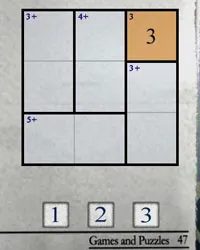
First things first. Look for the single-box cages. These are the freebies. There is no logic to apply here; the target number is the answer. Write it down. Move on.
Once those are clear, scan for cages with only one possible combination. Take a “3+” cage in any size grid. The only numbers that add up to three are one and two. You don’t know which goes in the top cell and which goes in the bottom, but you do know the pair exists. Lock that in mentally. It limits your variables.
Next, hunt for extremes. High or low target numbers relative to the cage size are your best friends.
“If you have a 6-by-6 puzzle with a two-cube cage that requires the large sum of 11, all you can use is a five and six.”
That’s a locked-in fact. Similarly, if you have a three-cube cage in that same grid needing a product of 10, there’s only one way to make that happen: one, two, and five. These unique answers act as anchors. They hold the puzzle together when everything else feels like fog.
When Math Fails, Use Sudoku Logic
Sometimes you’ll hit a wall. The arithmetic won’t resolve the conflict. That’s when you switch gears. Remember the golden rule of KenKen: every number must appear exactly once in every row and column. It’s the same constraint as Sudoku. If you’re stuck on a cage’s math, look at the surrounding cells in that row or column. If a number is already used there, it can’t go in your cage. Use that exclusion logic to narrow down your options.
Where To Start For Beginners
Don’t jump into the deep end. Start with a 3-by-3 grid. These are the training wheels of the puzzle world. They force you to understand the constraints without overwhelming your working memory. Once you get comfortable there, move to 4-by-4, then 6-by-6.
Also, pay attention to prime numbers. Successful players tend to gravitate toward cages with prime targets. Why? Because primes have fewer factor pairs. A target of 7 in a two-cell cage can only be 1 and 6 or 2 and 5 (wait, no, 2 and 5 is 7… okay, 1 and 6, 2 and 5). Actually